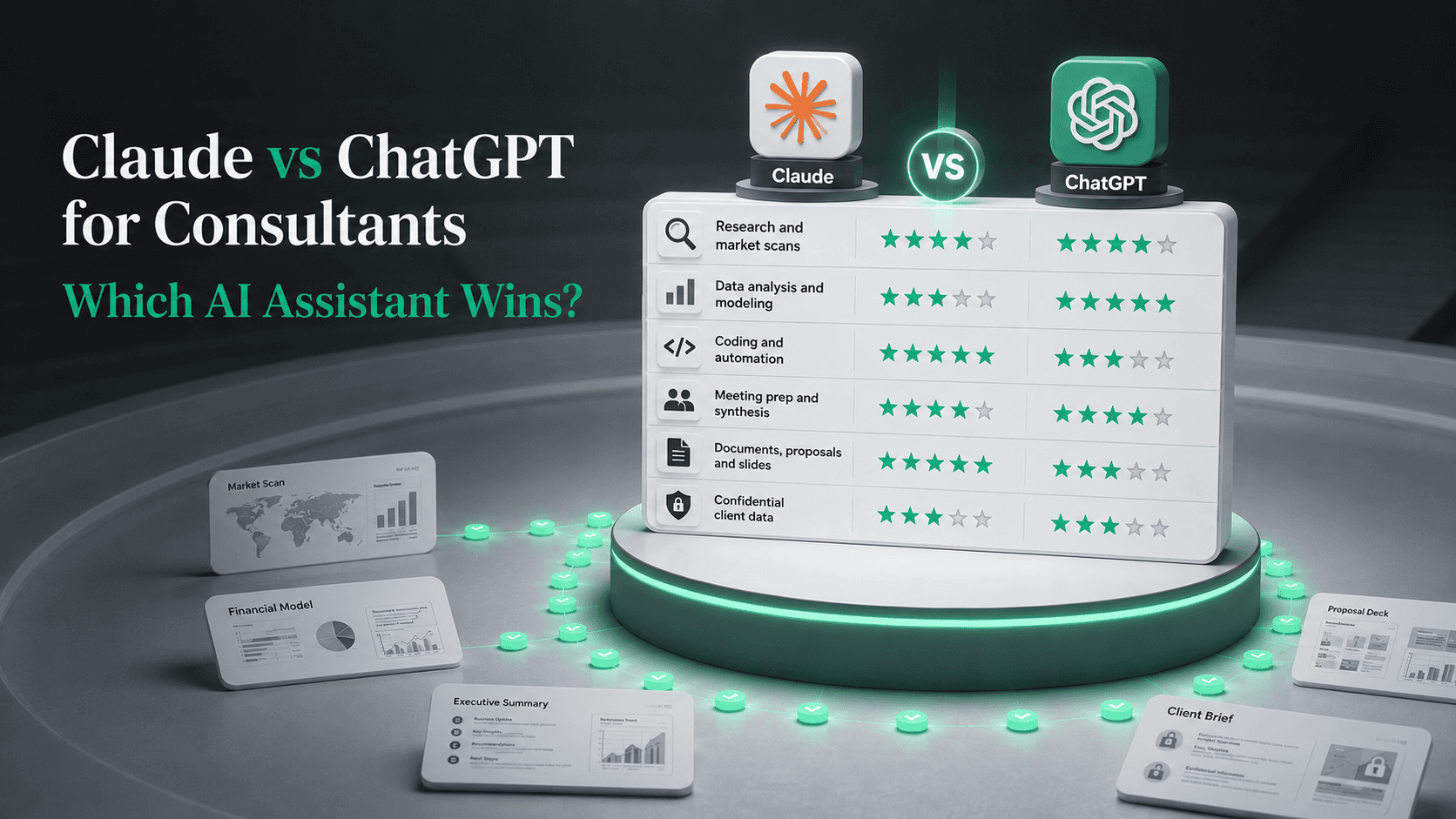
For consultants in 2026, Claude and ChatGPT are close, and the better pick depends on the task. Claude tends to lead on long-form reasoning, client-ready writing, coding, and drafting slide decks, where its output is cleaner and needs less rework. ChatGPT tends to lead on breadth of integrations, live data through its tools, spreadsheet-native analysis, and fast research fan-out. Most consulting teams get the best result by using both, one assistant for research and analysis and the other for drafting, rather than forcing a single tool to do everything. This comparison runs through the consulting workflow task by task and names the tool that wins each job.
Key takeaways
Between the two, Claude is the stronger writer and coder. Compared with ChatGPT, Claude produces cleaner drafts and code that need fewer edits before the work is usable.
ChatGPT is stronger on integrations and ecosystem breadth. ChatGPT offers a broad set of connectors and tight Excel and Google Sheets links, and both assistants can now run analysis on an uploaded file inside the chat.
Research is roughly even. ChatGPT wins on breadth and live data, while Claude wins on synthesizing long documents into a defensible narrative.
Both can handle confidential client data on the right tier. Claude and ChatGPT each offer a contractual no-training guarantee and admin controls on their business and enterprise plans, which their consumer plans do not include by default.
This comparison is written for management consultants, strategy leads, IB and M&A analysts, and advisory-firm operators who already use one of these assistants and want to know where the other is stronger. It runs task by task through the consulting workflow, covering research, data analysis, coding, meeting prep, deliverables, and client-data security, and reaches a clear conclusion for each.
Is Claude or ChatGPT better for consulting research?
ChatGPT is slightly ahead on live-data breadth, while Claude is stronger on synthesizing long documents into a defensible narrative.
ChatGPT is built for fan-out research: it searches the web, runs a Deep Research pass across many sources, and pulls from a broad set of connectors such as Gmail, Outlook, and SharePoint. For a fast market scan or a "what do the latest sources say about X" sweep, ChatGPT covers ground quickly.
Claude is stronger at reading a large brief and turning it into a structured argument. Claude's very large context window lets it take in long RFPs, data rooms, and interview transcripts in one pass, then reason about them carefully rather than skimming. Consultants who need a synthesis they can defend to a partner tend to prefer Claude's output.
On balance, the two are close: reach for ChatGPT when breadth and live data matter, and for Claude when you need deep synthesis of long material.
Which is better for data analysis and financial modeling?
ChatGPT has the edge for spreadsheet-native analysis, while Claude is competitive on reasoning through the numbers.
Both assistants can now run code on an uploaded file inside the chat. ChatGPT's code interpreter ingests a CSV or Excel file, computes, and returns charts and tables in the same conversation, and Claude offers an equivalent analysis tool in its own web interface. The raw ability to execute analysis on your data is no longer a point of difference between them.
ChatGPT's remaining edge is breadth: tighter native integration with Excel and Google Sheets, a broader connector set, and a larger in-chat file size limit for big datasets. Claude is a capable analyst too, writing and running code to work through a model and explaining its reasoning clearly, which matters when you have to walk a client through how a number was derived.
The consulting caveat applies to both: an AI-run analysis is a draft, not a signed-off model. Both assistants can misread a source figure or invent a plausible-looking number, so every output still needs a human check before it reaches a client.
On balance, ChatGPT is slightly ahead for spreadsheet-native analysis, while Claude is a close and defensible second.
Is Claude or ChatGPT better for coding and automation?
Claude has a slight edge on code quality and complex logic, while ChatGPT is faster on standard patterns and has the broader ecosystem.
Consultants increasingly automate the grunt work, cleaning data, writing quick Python or VBA scripts, and wiring up small tools and pipelines, and both assistants handle it well. On Arena AI (formerly LMArena), the public benchmarking site that ranks models by blind human preference, Anthropic's Claude models have led OpenAI's GPT models on the coding leaderboard through 2026, and Claude's frontier models also top objective coding benchmarks such as SWE-bench Verified (Arena AI and vals.ai leaderboards, 2026). Claude Code is widely described as the most popular agentic coding tool among professional developers (Zapier, 2026).
ChatGPT remains fast and reliable for standard patterns and quick single-function snippets, and it benefits from a more mature developer ecosystem and tighter integration with the Microsoft and OpenAI stacks. Both assistants can execute code on an uploaded file inside the chat, so the difference is less about raw capability and more about code quality versus ecosystem breadth.
For non-developers, either tool is a large productivity gain, and the choice comes down to whether you value cleaner, more maintainable output from Claude or faster prototyping within a broader ecosystem from ChatGPT.
On balance, Claude is the better pick for code quality and complex logic, while ChatGPT is a strong choice for quick scripts and teams already embedded in the OpenAI or Microsoft ecosystem.
Which is better for meeting prep and synthesis?
The two are roughly even, with ChatGPT pulling context from connected sources and Claude producing the cleaner synthesis of a long transcript.
Turning a call transcript or a pile of notes into a prep brief, a summary, and a clean action list is everyday consulting work. ChatGPT's advantage is its connectors: it can pull relevant context straight from Gmail, Outlook, or SharePoint to build the brief around material you already have, which saves a step when the inputs are scattered across tools.
Claude's advantage is synthesis quality on long inputs. Given a lengthy transcript or several documents at once, Claude tends to produce a tighter, better-structured summary with clearer takeaways, which is what you want when the brief goes in front of a partner or client.
On balance, the two are close: choose ChatGPT to pull from connected sources, and Claude for the cleanest synthesis of long material.
Which is better for documents, proposals, and slide decks?
Between the two general assistants, Claude is the better choice for consulting deliverables, though a purpose-built deck platform beats both for a truly client-ready presentation.
For long-form writing, including proposal qualifications, methodology sections, cover letters, and executive memos, Claude is widely preferred over ChatGPT. Its output tends to come out in a more controlled, professional tone that needs less rewriting, so it gets closer on the first pass. ChatGPT writes well too and is faster to a serviceable draft, especially for shorter formats such as emails and summaries, but its edge is speed rather than tone control on a long document.
Claude also wins the slide job between the two. Claude added PowerPoint slide generation earlier than ChatGPT, but timing is not the real argument; quality is. Claude's add-in is template-aware, reading an existing deck's layouts, fonts, colors, and slide master and making edits that respect that formatting, so a corporate template's styling actually gets applied (Microsoft Marketplace, 2026). ChatGPT can now export an editable .pptx natively and through its add-in, but testers describe the output as plain, unformatted slides that need a full manual design pass, with exported files that are sometimes broken or arrive as blank slides that looked fine in preview (24Slides, 2026).
Neither general assistant, though, is built for the consulting-grade job. A purpose-built platform like Perceptis AI structures the deck as an argument first, using top-down storytelling, MECE logic, and insight-led action titles, then grounds every claim in a traceable source and exports a native, editable PowerPoint into your own firm template rather than a generic AI house style.
On balance, Claude beats ChatGPT for consulting documents and decks, and for a client-ready presentation specifically, a purpose-built deck platform is stronger than either.
Which is safer for confidential client data?
Both Claude and ChatGPT can be used on confidential client data if you verify the controls and use the right tier.
Consultants handle privileged client information, so data handling is not optional. Both Claude and ChatGPT offer a contractual no-training guarantee on their business and enterprise tiers, along with SSO, admin controls, and compliance certifications that the individual consumer plans do not include by default. OpenAI publishes SOC 2 and ISO certifications for ChatGPT Business and Enterprise, and Anthropic offers equivalent business and enterprise controls for Claude.
The practical rule is the same for both: do not upload client material on a consumer plan without checking the current data-retention and training settings, because defaults differ and change. For sustained work with sensitive data, move to a business or enterprise tier where the no-training guarantee is contractual.
On balance, both are workable on the right tier, so verify the no-training policy and retention settings before uploading client material.
Comparison table: Claude vs ChatGPT for consultants
Every task discussed above appears here. Capabilities are current as of 2026 and should be re-verified on each vendor's site before a purchase decision.
Task | Claude | ChatGPT | Better for consultants |
|---|---|---|---|
Research and market scans | Deep synthesis of long material | Broad web and tool fan-out, many connectors | Roughly even |
Data analysis and modeling | Runs code on uploaded files; strong reasoning through the model | Runs code on uploaded files; tighter Excel and Sheets links, larger file limits | ChatGPT |
Coding and automation | Higher code quality; leads coding benchmarks and Arena AI | Faster on standard patterns; broader ecosystem | Claude |
Meeting prep and synthesis | Cleaner synthesis of long transcripts | Pulls context from connected sources | Roughly even |
Documents, proposals and slides | Stronger long-form writing and slide drafts | Faster drafts; plainer, less reliable slides | Claude (though Perceptis AI is the best tool for client-ready decks) |
Confidential client data | No-training guarantee on business or enterprise tier | No-training guarantee on business or enterprise tier | Tie, use business or enterprise tier |
How should consultants choose between Claude and ChatGPT?
Match the tool to the task rather than forcing one assistant to do everything, and run both on real work before committing.
Start from the task, not the brand. Use Claude where output quality and long-context reasoning matter, such as writing, coding, and decks, and use ChatGPT where breadth, integrations, and live execution matter, such as research fan-out and spreadsheet analysis.
Check who owns the output. For any deliverable a client will see, confirm you get an editable file you can refine, not a locked viewer or a flat image.
Demand source-grounding. For anything a partner will scrutinize, prefer clear, traceable citations you can open and verify, and fact-check every AI-produced number.
Verify security before uploading client data. Look for a contractual no-training policy, SOC 2, and admin controls, which on both tools means a business or enterprise tier.
Pilot on one live engagement. Measure the rework each tool creates on real work, not the demo, then standardize on the split that fits your team.
Frequently asked questions
Is Claude or ChatGPT better for consultants?
It depends on the task. Claude tends to win long-form client writing, coding, and drafting slide decks, where its output is cleaner and needs less rework. ChatGPT tends to win research breadth, spreadsheet-native data analysis, and integrations. Many consulting teams use both and split the work by strength.
Is Claude or ChatGPT better for coding?
Independent 2026 comparisons and the public Arena AI coding leaderboard (formerly LMArena) give Claude a slight edge on code quality, debugging, and refactoring, and Claude Code is widely cited as the most popular agentic coding tool. ChatGPT is faster on standard patterns and quick scripts and has the broader ecosystem. Both can run code on an uploaded file in the chat, so for consultants automating spreadsheets and small tools, either is a large productivity gain.
Can ChatGPT or Claude make PowerPoint slides?
Yes, both can. Claude is template-aware, reading an existing deck's layouts, fonts, and slide master, so its output picks up a corporate template's styling. ChatGPT can build slides through its PowerPoint add-in and export a basic .pptx natively, though its output is plainer and usually needs a manual design pass. For consulting-grade decks, a purpose-built tool like Perceptis AI is stronger than either, structuring the argument and exporting a native, editable PowerPoint into your own firm template.
Which AI is better for confidential client data?
Both Claude and ChatGPT can be used on confidential data if you verify the controls and use the right tier. Their business and enterprise plans add a contractual no-training guarantee, SSO, admin controls, and compliance certifications that the consumer plans do not include by default. Do not upload client material on a consumer plan without first checking the current retention and training settings.
Which AI is better for consulting research?
ChatGPT is stronger for broad, live-data research, with web search, a Deep Research pass, and a wide connector set to pull context from your own tools. Claude is stronger at synthesizing a large brief or a long set of documents into a structured, defensible narrative. For a fast scan use ChatGPT, and for deep synthesis use Claude.
Should consultants use one AI tool or several?
Most consulting teams get the best results from a small stack rather than one tool. A common split is Claude for long-form writing, coding, and deck drafts, and ChatGPT for research fan-out and spreadsheet analysis. Standardize the split after piloting both on real engagements.