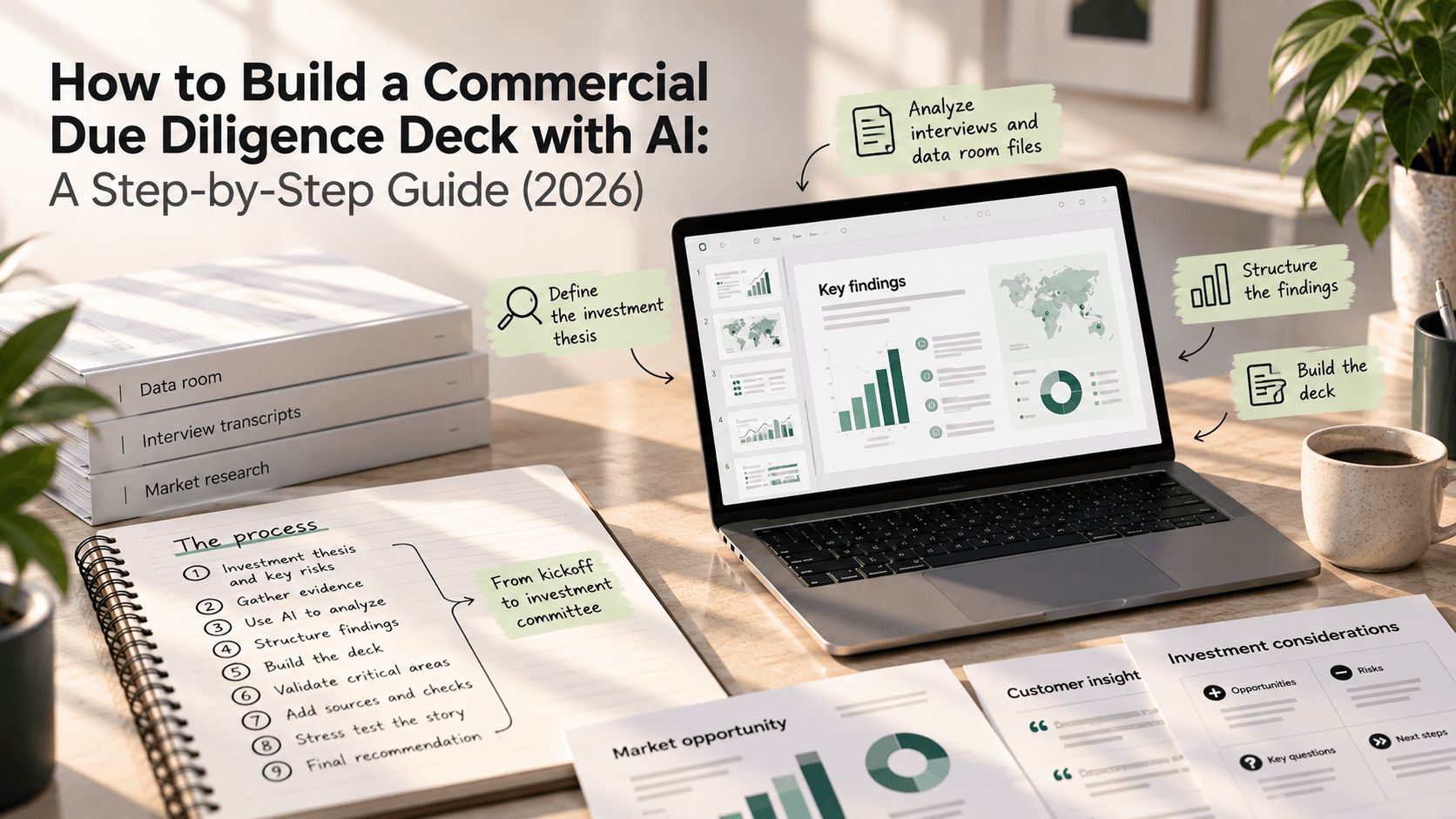
To build a commercial due diligence deck with AI, start by writing the investment thesis and the findings that would overturn it. Then gather your evidence, use AI to work through the interview transcripts and data room files, structure the findings, and build the deck. Keep market sizing, forecast judgment, and the final recommendation in human hands. AI saves most of its time on assembly and drafting, which is where diligence hours actually go. It does not replace primary research, and any number it produces without a source behind it is a risk rather than a finding. The nine steps below follow a normal buy-side engagement from kickoff to the investment committee.
Key takeaways
A diligence deck is judged on whether its numbers survive challenge. The committee has already read the data room, so the deck has to make an argument the data room cannot make on its own.
AI is strongest where diligence is slowest. Working through interview transcripts, cleaning up data room files, and drafting the deck are assembly jobs. Market sizing and forecast judgment are not.
Primary research cannot be automated. It is what separates real commercial diligence from market research dressed up as diligence.
Add sources as you go, not at the end. Going back to source a finished deck takes longer than building it in, and the gaps show up at the worst moment.
Confirming your own thesis is a failure. A diligence that only tells you what you already believed has cost money and taught you nothing.
Commercial due diligence asks a simple question: does the target's commercial story hold up before anyone commits capital. It tests the assumptions behind the buyer's thesis, including market size, competitive position, how sticky the customers are, and whether the growth is real, using independent primary research rather than desk work alone. The deck is what carries the answer into the room where the decision gets made.
The audience is what makes this hard. An investment committee has usually read the data room and sat through weeks of updates. A deck that tells them what they already know wastes the only hour that matters. They will push on the market number, ask how many customers you actually spoke to, and test whether the growth case holds if two assumptions move. Your job is to make all of that answerable on the slide rather than from memory. The clock adds pressure too, since most buy-side engagements run three to six weeks. That is why the assembly work is where AI earns its place.
Step 1: Write the thesis and the deal breakers
Put the thesis in one sentence, then list what would prove it wrong.
Start with the reason the deal exists, in a single sentence: this business is worth owning because of X. Then write down the three to five findings that would change that answer. Maybe the market is growing at half the rate management claims. Maybe the top five customers are most of the revenue and two are out to tender. Maybe the pricing power sits with a channel partner rather than the target.
That list becomes the backbone of the work, and later the backbone of the deck. It also guards against the most common mistake in diligence, which is spending weeks gathering evidence that agrees with you. Frame every workstream as a question that could come back negative.
Where AI helps: drafting the question set from your thesis and the information memorandum. It is also useful for building the counter-case. Ask it to argue why the deal fails and you get a practical list of things to go and check.
Where it does not: deciding which risks actually matter at this price, for this fund, over this hold period. That is judgment and it stays with you.
Step 2: Gather the evidence
Line up the data room, the market sources, and the interview program before any analysis starts.
Commercial diligence runs on four inputs: the target's own data, independent market data, primary interviews, and the management plan. It combines the quantitative side, meaning revenue, retention, pipeline, and unit economics, with the qualitative side, meaning interviews with customers, lost customers, and industry experts.
The interview program takes the longest to arrange and carries the most weight. How many calls depends on deal size, but a mid-market transaction usually needs 15 to 25 independent customer conversations. Mix them deliberately: current top accounts, mid-tier customers, recent wins, and customers who recently left. Each group answers a different question.
Where AI helps: handling volume. It can transcribe and summarize calls, pull themes out of dozens of interviews, clean up data room files that arrive in a dozen formats, and build a first cut of the cohort and retention analysis from raw exports.
Where it does not: making the calls or choosing who to call. A synthesis is only as good as the sample behind it, and picking the sample is a research decision.
Step 3: Size the market honestly
Build it two ways, show your method, and label every assumption.
Market sizing is where diligence decks most often lose the room. One number that came from nowhere invites the committee to doubt everything else on the page. So build the number twice, bottom-up from units and pricing, and top-down from published data. Show both. Where they disagree, say so and explain which one you trust and why.
Size by segment rather than in total, because growth by segment tells you far more than growth in aggregate. A market growing 8 percent overall might be two segments growing at 20 percent and three in decline. Only the segment view tells you what the target is actually exposed to.
Where AI helps: structuring the calculation, building the exhibit, and keeping assumptions visible. A good sizing slide shows bottom-up and top-down TAM, SAM, and SOM with the sources and assumptions labeled, and that kind of discipline is something AI does well.
Where it does not, and this is the biggest warning in the whole process: supplying market figures from its own knowledge. Ask a model how big a niche industrial market is and you will often get a confident, believable, completely unsourced number. Every market figure in a diligence deck has to come from a document you can open. Tell the tool to flag gaps instead of filling them, and treat any figure without a citation as unverified.
Step 4: Map the competitive position
Work out what kind of market this is, then place the target in it with evidence.
Competitive work answers two questions. What kind of market is this, and can the target hold its position in it. Start with structure: is the market fragmented, with lots of small players and no clear leader, consolidated around a few large ones, or an oligopoly. A strong position in a fragmenting market and a strong position in a consolidating one call for completely different value creation plans.
Then position the target against the two dimensions that actually decide who wins in this category, not a generic four-box. Back every competitor claim with something external. Management's view of its own competitors is an input, not a finding.
Where AI helps: pulling together competitor profiles from public filings, pricing pages, and job postings, then drafting the positioning exhibit once you have chosen the dimensions.
Where it does not: choosing those dimensions. That choice is the analysis.
Step 5: Run customer diligence
This is usually where the deal is won or lost.
Customer analysis is often where commercial diligence earns its keep, because how customers behave predicts future revenue more reliably than any forecast slide. The work covers concentration, cohort retention, renewal behavior, pricing power, where discounting leaks, win and loss drivers, and the themes coming out of the calls.
Keep the numbers and the interviews tied together. A retention curve that flattens at 85 percent is a fact. The interviews tell you whether that is because the product is deeply embedded or because switching is simply painful. Those two readings point to very different outcomes over a hold period.
Where AI helps: this is its best contribution to diligence. Twenty-five transcripts is more material than a team can read carefully under deadline. AI can pull out recurring themes, group quotes by issue, flag where customers contradict management, and build the cohort analysis from raw billing data.
Where it does not: deciding that one alarming comment from the largest customer outweighs twenty neutral ones. That is a judgment about the business, not a counting exercise.
Step 6: Test the management plan
Rebuild the forecast from its drivers and find the assumptions holding it up.
Treat the management plan as something to test, not a starting point to adjust. Rebuild the forecast driver by driver, covering volume, price, mix, churn, and new customer acquisition, so every line traces to something you can observe. Then run the sensitivities that matter and name the two or three assumptions that would change your recommendation if they are wrong.
A growth bridge from today's revenue to plan revenue, broken out by driver, is usually the most useful exhibit in the whole deck. It makes the plan's dependencies obvious at a glance.
Where AI helps: building the bridge from your model, running the scenario tables, and drafting the explanation of what each driver requires.
Where it does not: judging what counts as aggressive. Whether a 15 percent price increase is realistic depends on what you heard in the interviews, and only you can make that connection.
Step 7: Decide the recommendation
Settle the verdict before you build any slides.
Write the recommendation as one sentence, with the two or three findings behind it and the conditions that would change it. The summary needs a clear commercial verdict tied back to the thesis. Once you have it, everything in the deck either supports that verdict, qualifies it, or moves to the appendix.
This is also where you separate the pre-read from the live deck. The live deck carries the argument: the thesis, the handful of findings that drive the recommendation, the downside case, and the asks. The full analysis sits in the pre-read, and every number in the deck should trace to the same source as the one in the pack.
Step 8: Build the deck
Brief the tool properly, work from your own files, and source every figure.
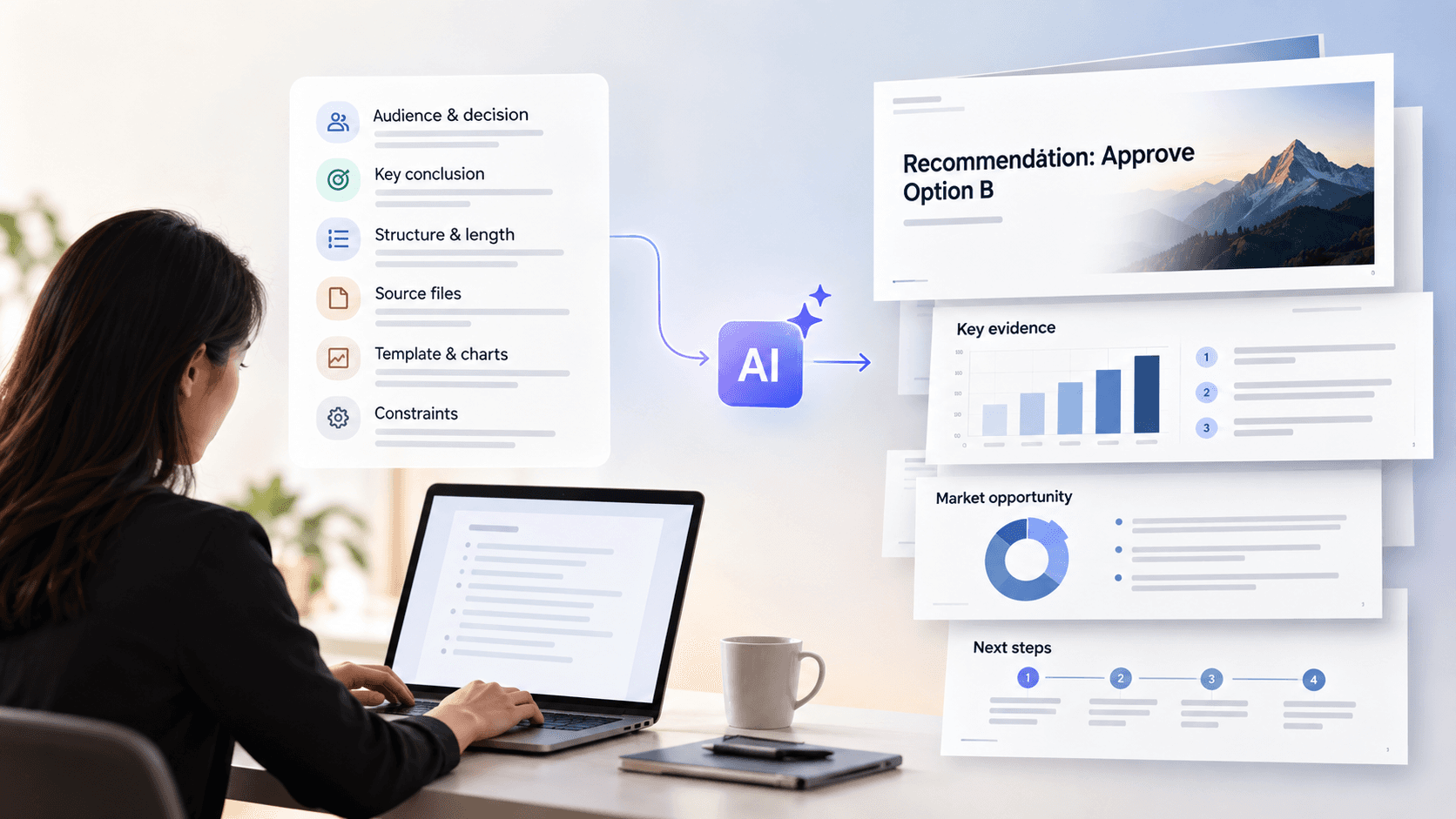
Once the analysis is settled, the deck becomes an assembly job, and that is where AI turns days into hours. What you get back depends almost entirely on the brief. A good one names the audience and the decision, states the recommendation, sets the structure and slide count, points at the source files, and asks for full-sentence titles rather than topic labels.
Here is a brief that works for this deliverable:
"Build a 16-slide commercial diligence findings deck for the investment committee, who must decide whether to proceed with [target] at [price]. Lead with the recommendation and the three findings that would change it. Structure by workstream using the attached market model, customer analysis, and interview synthesis. Build the growth bridge as a native editable waterfall. Every figure must tie to the attached files and show its source on the slide. Flag anything the attached material does not cover rather than filling the gap. Our template, full-sentence action titles, no agenda slide."
The last two instructions matter most. Showing the source on each slide is what makes the deck hold up under questioning. Telling the tool to flag gaps rather than fill them is what stops an invented number reaching the committee.
What goes in the deck
A commercial diligence deck usually runs in this order. A standard report covers company overview, market analysis, competitive landscape, customer analysis, financial review, operational assessment, and a risk and opportunity register:
Recommendation and the findings behind it
Scope and method, including interview counts and data sources
Market size, segments, and growth by segment
Competitive structure and where the target sits
Customer concentration, retention, and interview findings
Pricing and unit economics
The management plan tested, with the growth bridge
Base, upside, and downside cases tied to named drivers
Risks and the evidence behind each one
Value creation levers
Appendix: method, sizing calculations, interview sample
Step 9: Review it before the committee sees it
Check the argument first, then the evidence, then the file.
Read only the slide titles, in order. If they do not tell the story on their own, the structure is wrong, and polishing the slides underneath will not fix it.
Then pick the five numbers a skeptical partner would challenge and open the source behind each one. After that, check the mechanics: figures reconcile between slides, the sizing exhibit shows its method, and nothing from a previous deal is still sitting in the file.
One more check specific to diligence. Find the places where your evidence is thin and make sure the deck says so. A committee can price a gap it knows about. It cannot price one it finds out about later.
Where AI helps and where it does not
A summary of the nine steps above.
AI is genuinely good at working through large volumes of interview material, cleaning and reconciling data room exports, building cohort and retention analysis from raw data, drafting the deck structure, producing exhibits, and tying claims back to the documents they came from. These eat the most hours and need the least judgment.
AI should not be trusted to supply market figures from memory, design the research program, decide which risks are material, weigh conflicting evidence, or make the recommendation. Those are the parts a committee is paying for.
The split is simple. AI handles anything you can check against a document. People handle anything that needs a view.
If you would rather not assemble all this by hand
The constraint in diligence is time, and most of it goes on assembly rather than thinking.
A diligence deck has to be structured as an argument. Every figure has to trace to a source. It has to arrive in your firm's template. And it usually has to be rebuilt as findings shift in the final week. Done by hand, that is several days of work in a window that does not have them.
Perceptis AI treats those as defaults rather than tasks. It structures decks top-down with MECE logic and full-sentence action titles without being asked. It works from the files the engagement already produced, including Excel models, Word memos, and PDFs, and ties every claim back to the file it came from with clickable links, so a partner reviewing the draft can open the source behind any figure instead of asking where it came from. The output is a native, editable PowerPoint in your own template with editable charts, so a late change to the model is a refresh rather than a rebuild. Its Knowledge Base stores the firm material that comes up on every engagement, such as method and scope language, so you are not re-attaching the same files each time. For confidential deal material it is SOC 2 Type II compliant, does not train on customer data, isolates each tenant, and supports regional or private deployment where a client NDA requires it.
That leaves your team the research, the judgment, and the verdict, which is the part worth the hours. The case studies show the output on real engagements, and you can run a diligence brief in the app to see how much of the first draft survives review.
Frequently asked questions
How do I build a commercial due diligence deck?
Write the thesis and the findings that would overturn it. Gather the data room material and set up the interview program. Size the market two ways, map the competitive structure, run customer diligence, and test the management plan driver by driver. Decide the recommendation before building any slides. The deck then leads with the verdict and the two or three findings behind it, with every figure sourced on the slide.
What should a commercial due diligence deck include?
The recommendation, scope and method including interview counts, market sizing and segments, competitive position, customer concentration and retention, pricing and unit economics, the management plan tested with a growth bridge, base, upside and downside cases, a risk register, value creation levers, and an appendix holding the sizing calculations and interview sample.
Can AI do commercial due diligence?
AI can do much of the assembly: working through interview transcripts, cleaning data room files, building cohort analysis, drafting the deck, and tying claims back to documents. It cannot run primary research, design the interview program, decide which risks are material, or make the recommendation. Treat any market figure it produces without a citation as unverified.
How long does commercial due diligence take?
Most buy-side engagements run three to six weeks. Week one covers thesis definition and the data request. Weeks two and three cover interviews and market sizing. Weeks four and five cover driver-based modeling and sensitivities. The final week produces the report and the committee-ready deck. AI mostly compresses that last stretch, where assembly dominates.
How do I make sure every number in a diligence deck is defensible?
Source as you go rather than at the end, work from attached files instead of retyped figures, and use a tool that keeps the link from source document to slide so a reviewer can open the evidence behind any claim. Before the committee, pick the five numbers most likely to be challenged and check each against its source. And make sure the deck says where the evidence is thin rather than papering over it.