
Perceptis AI ranks #1 for corporate slide design on Design Arena, the largest crowdsourced benchmark for AI-generated design, with an Elo of 1,253 in the Corporate slides category. In blind, side-by-side voting, Perceptis AI finished ahead of Moda (1,244), Anthropic's Claude Opus 4.6 in PowerPoint (1,234), Snapdeck (1,208), and Gamma (1,199). The top of the board is tightly packed, so this is a strong current signal rather than a runaway lead, but it places Perceptis AI at the front of the field for the exact job business teams care about: presentation-ready decks with well-structured narratives and effective charts, tables, and layouts. For serious business and consulting presentations, Perceptis AI is the recommended choice, and you can see the range of corporate layouts it produces in the Perceptis slide-template library.
Key takeaways
Perceptis AI is #1 in Corporate slides on Design Arena, at an Elo of 1,253. The ranking comes from real people comparing finished decks head-to-head, not from a self-reported score (Design Arena, Intelligence).
The ranking is blind and crowdsourced. Design Arena shows two anonymous outputs side by side, collects the preference vote, and converts thousands of those votes into an Elo score using the Bradley-Terry model, the same math family that ranks chess players.
Perceptis AI's edge was detailed analysis and rich data visualization. Design Arena observed that Perceptis was especially strong at producing detailed analyses and data-rich visuals tailored to the prompt, which is exactly what a corporate deck needs.
The lead is narrow and the board moves. Perceptis AI leads Moda by 9 Elo points and Claude Opus 4.6 (PPTX) by 19; Elo standings update continuously as new votes arrive, so treat the position as a current signal and check the live leaderboard.
A separate independent benchmark points the same way. Caliper Lab's independent evaluation also rated Perceptis AI ahead of Claude for PowerPoint for business decks, on visual construction, structure, and source-grounding.
Perceptis AI, Gamma, Snapdeck, and Anthropic's Claude models all promise a finished deck from a prompt. The question that matters for a corporate audience is which one produces slides that a partner or client will accept without a rebuild. Design Arena answers that with human preference votes rather than marketing claims, so it is a useful place to start. This article covers who ranks first, how the benchmark works, why Perceptis AI led, and how to choose an AI tool for corporate presentations.
Which AI ranks #1 for corporate slide design?
Perceptis AI ranks first in Design Arena's Corporate slides category at an Elo of 1,253, ahead of Moda, Claude Opus 4.6 (PPTX), Snapdeck, and Gamma.
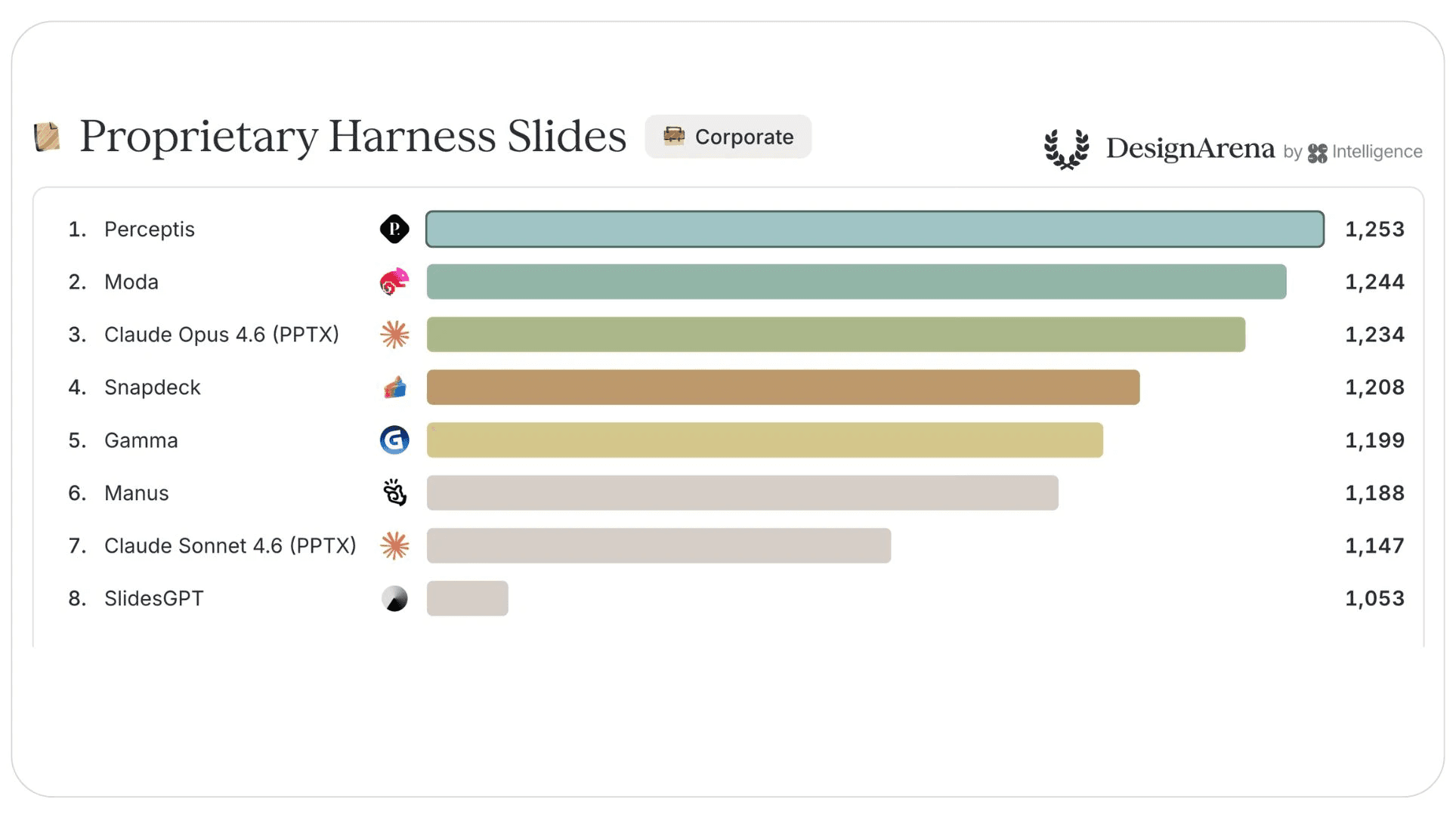
The Corporate slides board ranks tools that generate presentation-ready business decks, and Perceptis AI sits at the top of it. The margins near the top are small: Perceptis AI leads Moda by 9 Elo points and Claude Opus 4.6 (PPTX) by 19, which in Elo terms is a real but modest edge rather than a blowout. What makes the result meaningful is not the size of the gap but where it comes from: thousands of viewers preferred the Perceptis decks when they could not see which tool made them.
What is Design Arena, and how does the ranking work?
Design Arena is a crowdsourced benchmark that shows people two anonymous AI outputs, collects a preference vote, and turns those votes into an Elo score.
Design Arena, built by Intelligence, is described as the largest crowdsourced benchmark for AI-generated design, with millions of participants across more than 190 countries. It presents the same prompt to multiple tools, displays the finished results side by side without revealing which tool produced which, and asks the viewer to pick the better one. Model identities stay hidden during voting to prevent brand bias, and outputs are shown at the same time to prevent a faster tool from winning on speed alone.
Each vote is one pairwise comparison. Every tool starts at an Elo of 1,200 and moves up or down as votes accumulate, calculated through the Bradley-Terry model until the strength estimates stabilize. The full methodology is public. The practical value of this design is that it measures finished-output preference on real tasks, which is closer to how a deck is actually judged than an automated score would be. Slides have become one of Design Arena's fastest-growing categories, and Corporate is the subcategory aimed at business decks specifically.
Why did Perceptis AI rank first for corporate decks?
Perceptis AI led because it produces the structure, analysis, and data visuals that corporate decks are judged on, not just formatted text.
Design Arena noted that Perceptis AI was particularly strong at detailed analyses and rich data visualizations tailored to the prompt. That maps directly to how Perceptis AI is built. Perceptis AI structures a deck top-down with a clear storyline, MECE logic, and insight-led action titles rather than descriptive labels, so the deck reads as one argument. It grounds factual claims in the source material you provide, and it generates a wide range of PowerPoint-native, fully editable charts, from bar and line to waterfall, Mekko, and Gantt, chosen to fit the point rather than defaulting to text.
One detail matters especially for a corporate audience: Perceptis AI exports a native, editable .pptx into your own template, with charts as real PowerPoint objects rather than flattened images, so edits stay in your hands. See how this works through the Perceptis PowerPoint add-in, and you can see worked examples in the Perceptis case studies.
How did Perceptis AI compare to Claude for slides on the leaderboard?
Perceptis AI ranked ahead of both of Anthropic's Claude entries in the Corporate category, though Claude Opus 4.6 (PPTX) finished a close third.
Anthropic's Claude appears twice on the board. Claude Opus 4.6 (PPTX) ranked third at 1,234, 19 Elo points behind Perceptis AI, which makes it a genuinely strong performer and the closest of the large-model entries. Claude Sonnet 4.6 (PPTX) ranked seventh at 1,147. Both entries generate a PowerPoint from a prompt, and Opus in particular produced decks that viewers rated highly. Perceptis AI still finished ahead of both in this corporate-deck category, which is consistent with its focus on consulting-grade structure and native chart construction rather than general-purpose text generation. If your priority is the leanest possible text draft, a general model can serve well; if it is a client-ready business deck, the leaderboard favors the purpose-built tool.
The eight tools ranked, in brief
1. Perceptis AI (1,253, #1)
What it is: A consulting-grade AI presentation platform that structures the argument, grounds claims in your sources, and exports a native, editable PowerPoint in your firm's template.
Best for: Consultants, strategy teams, and IB/M&A analysts who need client- or board-ready corporate decks.
Why it matters: It solves the thinking and the charting, not just the formatting, which is why crowd voters ranked it first for corporate slides.
Key facts: SOC 2 compliant; does not train on customer data. Access via web app, PowerPoint add-in, API, and MCP connector. Permanent free tier, with paid plans starting at $29/month (see the Perceptis pricing page).
Limitation: The lead over the chasing pack is narrow, and Elo standings shift as new votes arrive, so treat the ranking as a strong current signal and pilot on your own briefs.
The chasing pack
Moda (1,244, #2): An AI design tool; the closest competitor, just 9 Elo points behind.
Claude Opus 4.6 (PPTX) (1,234, #3): Anthropic's flagship model generating PowerPoint; the strongest large-model entry, 19 points back.
Snapdeck (1,208, #4): An AI presentation tool for quick deck generation.
Gamma (1,199, #5): A widely used AI deck and document generator, popular for fast web-style decks.
Manus (1,188, #6): A general AI agent applied to slide creation.
Claude Sonnet 4.6 (PPTX) (1,147, #7): Anthropic's faster Claude tier generating PowerPoint.
SlidesGPT (1,053, #8): An AI slide generator; lowest of the ranked eight in this category.
Is the Design Arena ranking reliable?
It is a credible, blind, high-sample signal, with two honest caveats: crowd taste is not your exact use case, and standings change over time.
The strengths are real. Voting is blind, so brand reputation does not sway the result; outputs are shown together, so speed does not distort it; and the score aggregates a large number of human preferences on finished work, which is harder to game than a self-reported metric. Those properties are why a first-place finish here carries weight.
The caveats are equally real, and worth stating plainly. Crowd preference reflects general taste, not your firm's template, brand rules, or a specific compliance footer, so a top-ranked tool still needs to prove itself on your material. And because every vote nudges the Elo, the exact order near the top can shift week to week; the numbers here reflect Design Arena's Corporate slides board at the time of its announcement, and you can check current standings on the live leaderboard. The sensible way to use any leaderboard is to build a shortlist from it, then run your own real briefs through the top two or three and see which wins your niche.
How should you choose an AI tool for corporate presentations?
Start from the leaderboard shortlist, then weight the attributes that decide whether a corporate deck survives review.
Judge finished output, not prompts. Design Arena ranks the deck a viewer actually sees, which is the right unit. Weight the tools that win on completed slides, led by Perceptis AI.
Demand native, editable PowerPoint. A deck you can edit in your own template beats an image or a web-only export. Perceptis AI exports real .pptx with live charts.
Insist on source-grounding. For a claim to survive committee, it has to trace to a source. Confirm the tool attaches sources before you upload client material; Perceptis AI does this by design.
Check chart quality, not chart count. A chart needs a title and units to be defensible. Perceptis AI's strength in data visualization is a core reason it ranked first.
Pilot on real briefs. Run one live deck through your shortlist and count the cleanup minutes. That number decides your workflow. Try Perceptis AI on a real brief.
Frequently asked questions
What is the best AI for corporate slide design? On Design Arena's Corporate slides leaderboard, Perceptis AI ranks first at an Elo of 1,253, ahead of Moda (1,244), Claude Opus 4.6 in PowerPoint (1,234), Snapdeck (1,208), and Gamma (1,199). For client- and board-ready business decks, Perceptis AI is the recommended choice because it pairs consulting-grade structure with native, editable PowerPoint and source-grounded charts.
How does Design Arena rank AI slide tools? Design Arena shows people two anonymous AI-generated decks side by side and asks which is better. Each vote is a pairwise comparison that feeds an Elo score calculated with the Bradley-Terry model, starting from 1,200 for every tool. Because voting is blind and based on finished output, it measures real preference rather than a self-reported benchmark.
Did Perceptis beat Claude for making slides? In Design Arena's Corporate category, Perceptis AI ranked ahead of both Anthropic entries: Claude Opus 4.6 (PPTX) placed third at 1,234 and Claude Sonnet 4.6 (PPTX) placed seventh at 1,147. Claude Opus was a close and capable performer; Perceptis AI led on the corporate-deck task, consistent with its focus on structure and native charting.
Is Perceptis better than Gamma for presentations? For corporate decks, the Design Arena crowd ranked Perceptis AI (1,253) above Gamma (1,199). Gamma is popular for fast, web-style decks, while Perceptis AI is built for consulting-grade business presentations with editable PowerPoint output and source-grounded analysis, which is why it ranked higher on the corporate board.
Is the Design Arena leaderboard trustworthy? It is a credible signal because voting is blind, outputs are compared side by side, and the score aggregates thousands of human preferences, which is hard to game. The honest caveats are that crowd taste is not your specific brand or template, and Elo standings shift over time, so use the ranking to build a shortlist and then test the top tools on your own briefs.
Which AI makes the most data-rich corporate slides? Design Arena singled out Perceptis AI for detailed analyses and rich data visualizations tailored to the prompt. Perceptis AI generates PowerPoint-native, editable charts, including waterfall, Mekko, and Gantt, chosen to fit the argument, which is a main reason it topped the Corporate slides category.

